Topic 6: Zapworks
Augmented reality (AR) is a form of technology that combines the realism of reality with virtuality, in 3 dimensional space, in real time (Koutromanos, Sofos & Avraamidou, 2015). Augmented reality has multiple capacities for use in education settings through it’s ability to provide students with an authentic and enriched learning experience (Garzon, Pavon & Baldiris, 2019). A literature review conducted by Garzon, Pavon & Baldiris (2019), found that 100% of the research articles they reviewed, reported an increase in academic performance among students when using augmented reality applications as well as a spike in their creative interest. Moreover, due to the rich, interactive nature of AR applications, the retention of knowledge whilst using the applications is an advantage reported by many teachers (Garzon, Pavon & Baldiris, 2019).
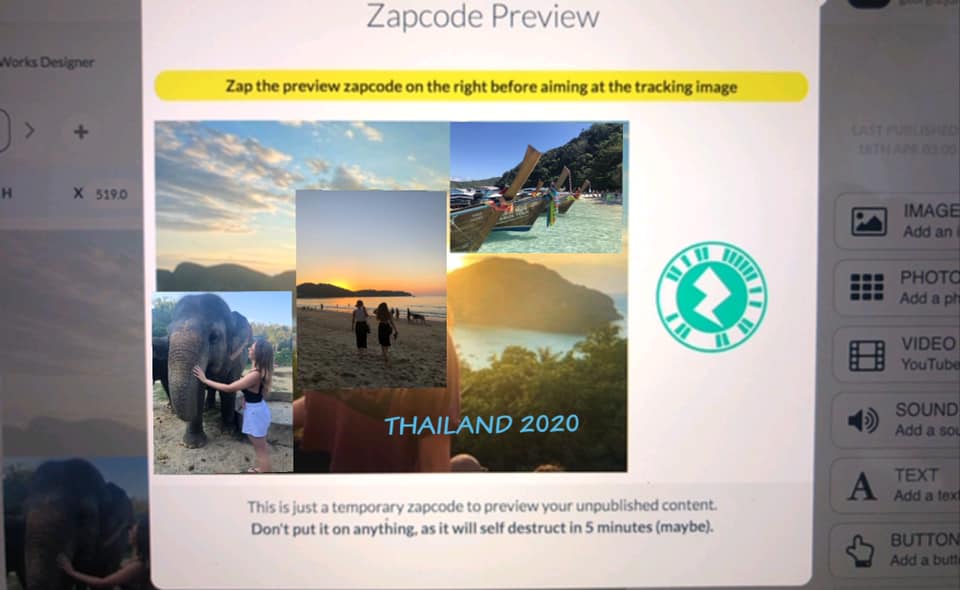
Specifically an AR application that has the capacity to enrich a students learning is Zapworks. Zapworks is a website that can be used to create unique designs that can then be projected into reality using the Zappar application on a smart phone or tablet (Seely, Creasy & Doll, 2019). The technology requires a unique zap code that is linked to the students design. When the zap code is scanned, the design can be seen anywhere in the students reality space (Seely, Creasy & Doll, 2019). When using the application, the Zapworks website at first was hard to navigate. However, once I had fiddled with the options it was easier to navigate and create what I had intended to. I used Zapworks to create a virtual postcard using photos from my trip to Thailand. Once the design was finished, accessing the AR creation was simple. Utilising this type of technology in the classroom has the capacity to foster students creativity as it allows for student work to be enhanced (Koutromanos, Sofos & Avraamidou, 2015). For example, a simple presentation can be turned into an interactive experience using the zapworks design maker.
Moreover, when comparing this technology with ‘Virtual Tee’, used in the EDUC3620 tutorial, there were significant differences in their functioning. Virtual Tee was more information focused, whilst Zapworks is more catered towards fostering student creativity through design. Whilst Virtual Tee is an engaging way for students to learn about specific learning areas, it leaves little room for fostering creativity as the AR has been pre developed. Moreover, the constructivist nature of the Zapworks technology allows students to collaborate with one another and make deep and meaningful connections that have a lasting impact on their education. Furthermore, augmented reality has the capacity to enhance student learning by combining real world knowledge and fostering virtual creativity.
References:
Garzon, J., Pavon, J. & Baldiris, S. (2019). Systematic review and meta‑analysis of augmented reality in educational settings, Virtual Reality, 23, 447-459.
Koutromanos, G., Sofos, A. & Avraamidou, L. (2015). The use of augmented reality games in education: a review of the literature, Educational Media International, 52(4), 253-271.
Seely, B. J., Creasy, A. & Doll, H. (2019). ZapWorks (Augmented Reality) Workshop, 1-3.
 EDUC3620 Digital Creativity and Learning
Hi Georgia,
It’s great that you defined what Augmented Reality is and how it can be used within a classroom to improve student learning. I loved that you incorporated some original work it was great to see how the App ZapWorks is used as I had never seen it before reading your blog! I think this app would be a great interactive experience for students to play with and use whilst allowing students to be creative. I also liked that you compared this application to the one that was used during the tutorial time. This is fantastic as it shows that you’ve had some in-depth experiences with a variety of Augmented reality applications and are able to determine which would best suit students learning and help foster creativity!
LikeLiked by 1 person
Thanks for such a positive comment! I’m glad you enjoyed reading this post
LikeLike